https://www.straitstimes.com/asia/south-asia/india-poll-results-show-bread-and-butter-issues-matter-more-than-hindu-card-appeal
In the end, Hindu nationalism holds limited appeal in India as bread-and-butter concerns rule

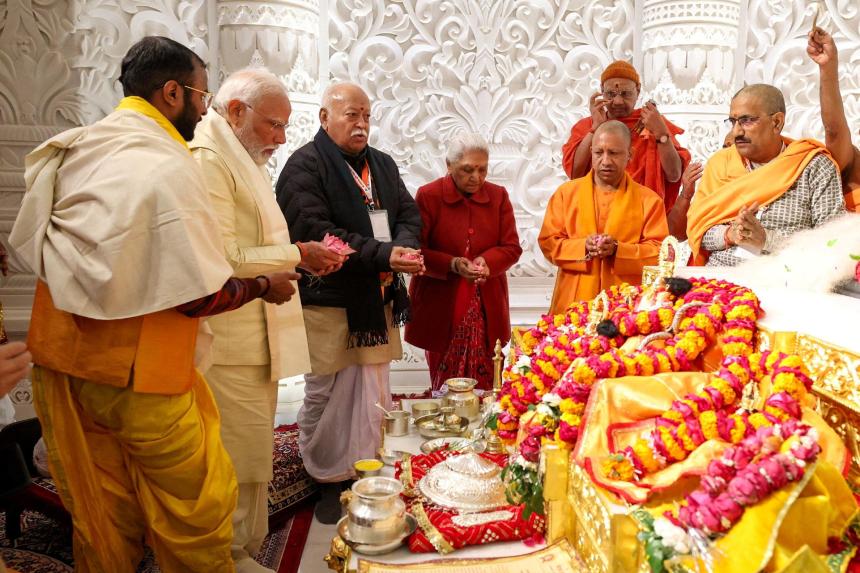
NEW DELHI – It was a triumphant moment for India’s Prime Minister Narendra Modi and his Bharatiya Janata Party (BJP) in January when he personally led the inauguration of a temple – with cameras clicking and priests in tow – at what was once a disputed site between Hindus and Muslims in Ayodhya.
The consecration of the Ram temple in the BJP’s stronghold of northern Uttar Pradesh state – a key promise in the party’s manifesto – was widely tipped to help the party ride a wave of Hindu triumphalism, and coast to certain victory in the 18th general election.
But the use of the temple as a campaign tool to mobilise Hindu votes did not yield the expected results, as pressing bread-and-butter issues such as unemployment and inflation turned out to be more important in the minds of voters.
While Mr Modi returned to power for a rare third term, he simultaneously suffered an electoral setback as the BJP failed to secure an outright majority for the first time since sweeping to power a decade ago.
According to polls results tallied on June 4, the BJP won only 240 seats in the Lok Sabha, or Lower House of Parliament, this time – far lower than the 370 it had aimed for – and falling short of the 272 seats needed to form a government on its own. The party has to now rely on the support of its allies in the BJP-led National Democratic Alliance (NDA) to hold on to power. In all, the BJP-led alliance has 292 seats.
“People have rejected religious polarisation because there was an overdose of Hindutva (Hindu nationalism) and hatred (directed) against Muslims,” said Mr Sharat Pradhan, a senior journalist and political commentator based in Lucknow, the capital of Uttar Pradesh.
“The BJP had overestimated the appeal of Hindutva and thought people would overlook real issues,” he told The Straits Times.
These issues include slow progress in job creation, agrarian stress, rising prices and recurring leaks of government recruitment exam papers that have held up the intake of youth desperate for secure jobs.
The BJP’s setback has been widespread, ranging from Uttar Pradesh to West Bengal in the east and to Maharashtra, the country’s richest state in the west, where it saw its support wane.
In Faizabad, the parliamentary constituency in Uttar Pradesh that includes the town of Ayodhya where the Ram temple is situated, BJP suffered a shock defeat, after having won there in 2014 and 2019. Displacement of people to make way for Ayodhya’s redevelopment alongside the temple’s opening and poor compensation were among the many factors that prompted discontent against the BJP in the region.
Another blow was the defeat of the BJP candidate from Shrawasti, a parliamentary seat around 100km away from Ayodhya. Mr Saket Misra, son of Mr Nripendra Misra, the bureaucrat heading the construction of the temple, lost by over 76,000 votes to Samajwadi Party’s Ram Shiromani Verma.
While the BJP had expected its success with the Ram temple to deal a definitive blow to the flagging opposition, the Indian National Developmental Inclusive Alliance (India) bloc, which includes the Congress party, enjoyed a revival and put up a good fight by exploiting the undercurrent of voter discontent.
In Uttar Pradesh, employment-related concerns were dominant. “People voted for change here because our MP (from the BJP) did not do any work here, except for whitewashing his failures with the Ram Mandir and Ram Path (one of the four roads leading to Ayodhya),” said Mr Vijay Yadav, a resident of Mitrasenpur village in Faizabad district. Currently unemployed, the 27-year-old told local media that he was a “victim” of the exam paper leaks and works with his father on their farm.
The unemployment rate in India rose to 8.1 per cent in April from 7.4 per cent in March, according to the private think-tank Centre for Monitoring Indian Economy.
Despite India’s sterling economic growth of more than 8 per cent in 2023-2024, rural distress has increased as incomes have fallen amid rising food prices especially for vegetables and grains.
In addition, political observers note that fears about the BJP introducing changes in the Constitution were prevalent, especially among marginalised caste groups, who benefit from affirmative action policies guaranteed by the state including reserved quotas in educational institutions and government jobs. This was another concern that the opposition seized upon, after some BJP leaders said that the party needed a two-thirds majority to make changes in the Constitution.
As the pan-Hindu momentum from the Ram temple consecration lost steam and reports trickled in showing the BJP faring poorly in the first phase of the polls that began on April 19, Mr Modi switched gears to an overtly communal campaign.
Among the several controversial remarks he made were those at a campaign speech in Banswara in north-western Rajasthan state on April 21, where he falsely claimed that the rival Congress party would confiscate the assets of Indians and distribute them to “infiltrators” and “those with more kids” – veiled and stereotypical references to Muslims in India.
This desperate and crude attempt at mobilising Hindu votes also failed for the BJP, with its Banswara candidate losing by 247,054 votes to the Bharat Adivasi Party’s representative.
Political observers say they now expect Mr Modi and other BJP leaders to tone down their communal rhetoric a few notches, given that the incoming coalition government’s survival depends on key allies like the Telugu Desam Party (TDP) and Janata Dal (United), or JDU, which do not share the BJP’s Hindu nationalist ideology.
The absence of “Jai Shri Ram” (Hail Lord Ram), which has been co-opted as a battle cry by the BJP and other right-wing Hindu organisations, in Mr Modi’s victory speech on the evening of June 4, was notable, they said.
“I think on many of their hardline Hindutva issues and cultural nationalism, they will definitely have to tone that down, at least in the beginning,” said Ms Arati R. Jerath, a Delhi-based senior journalist and commentator.
“Neither of their two major partners – the TDP or JDU – is enamoured with those policies or is part of that ideology,” she added.
Already a subscriber? Log in
Special offer: $0.25/week
Unlimited access to news, lifestyle & multimedia content!
ST One Digital - Monthly
$9.90/month $0.99/month
No contract
$0.99/month for the first 6 months, $9.90/month thereafter. T&Cs apply.
Discover exclusive benefits:
All subscriber-only content on ST app and straitstimes.com
Easy access any time via ST app on 1 mobile device
myST: Follow up to 30 authors and 30 topics
Join ST's Telegram channel and get the latest breaking news delivered to you.
Comments
Post a Comment